






Virtual Cloud Computing Platform (VCCP) for A*STAR
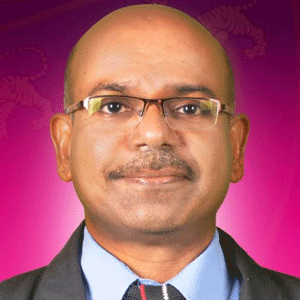
Dr. John Kan, CIO, A*STAR - Agency for Science, Technology & Research

Dr. John Kan, CIO, A*STAR - Agency for Science, Technology & Research
In the past, there used to be a small cluster of servers with limited resources available for users. This is now easily overcome by our A*STAR’s Virtual Cloud Computing Platform (VCCP) which was created for users to run and scale their applications.
With the VCCP, users experience full control over their virtual machines. The researchers are thus able to obtain results much faster as a result of the ease of setup through cloning and their ability to run multiple copies. Researchers use this service to run their research applications.
The VCCP provides scalable resources with a smaller footprint to our researchers. With the provision of the latest hardware and software, a single 2U space server can now house up to 50 Virtual Machines per host, contributing to Data Centre space and power cost savings.
In addition, the VCCP also helps aggregate all the computing resources (CPU, Memory) as one and minimizes the wastage of IT resources. Currently, more than 1,000 VMs form the VCCP.
VCCP Enables Organizations to Focus on Their Core Businesses Instead of Expanding Resources on Computer Infrastructure and Maintenance
Finally, the VCCP enables A*STAR researchers focus on their core research functions instead of having to worry about the computer infrastructure and maintenance. It allows the researchers to get their applications up and running faster, with improved manageability and less maintenance, leaving it to IT to rapidly adjust resources to meet fluctuating and unpredictable business demands. Our cloud computing also allows us to minimize up-front IT infrastructure costs.
With the implementation of the VCCP, A*STAR has benefitted from the following:
• Improved scalability, agility and flexibility in provisioning or expanding infrastructure resources.
• Cost reductions through lower server footprint, multi-tenancy and cost-sharing and utility-based computing model.
• Less reliance on in-house IT personnel who are re-deployed to higher value-added projects.
• “Access anywhere” using a web browser regardless of location or device used (e.g., PC, mobile phone).
• Central administration and more robust security.
• Increased productivity with multiple users working on the same data sets simultaneously.
• Pooled system resources and load balancing.
• Improved reliability through a well-designed cloud computing architecture suitable for business continuity and disaster recovery.
Most importantly, our IT-enabled VCCP has allowed our researchers to focus on their core research functions and contribute to A*STAR’s mission of greater economic and social outcomes.

Weekly Brief
Read Also

Artificial Intelligence - Myths And Truths

Sustainable Future through Innovative Technology Solutions

The Future Relies on Augmented AI
Digitalization with the use of digital technologies/Improving business through digital technologies

How Marco's Pizza Leaned On Technology To Succeed Amid The Pandemic By Quickly Pivoting To Contact-Free Delivery And Curbside Carryout

Bunnings Diy Digital Transformation

For a Smarter City: Trust the Data, Ignore the Hype